Note duration is represented by writing notes in different ways.
Whole note: 4 beats

Half note: 2 beats

Quarter note: 1 beat

Eighth note: 1/2 beat

Sixteenth note: 1/4 beat

The basic rhythmic values can be extended with dotted and tied notes. A tied note connects the value of two or more notes. A dotted note increases the value of the note by one half of the original value.
Half note tied to quarter note = dotted half note = 3 beats

Quarter note tied to eighth note = dotted quarter note = 1.5 beats

A rest is a silence with the same rhythmic value as a note with the same duration. Mute the strings to "play" a rest.
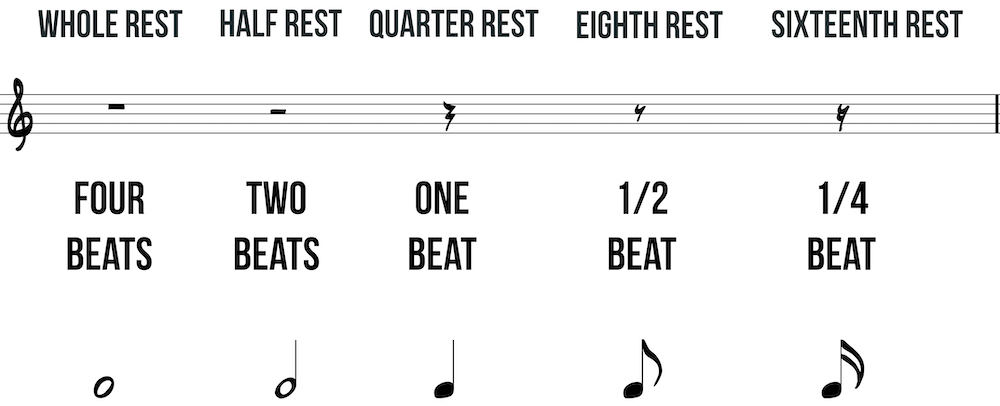
Practice reading the following rhythms by playing any note. Use a metronome to keep good time.





This YouTube video discusses much of the same material as the lesson:
Learning to strum evenly is an essential skill for every beginning guitarist. Keep your right arm and pick in constant motion. This helps you to feel the beat. Practice these strum patterns with a metronome (or drum beat) at varying tempos to develop a good time feel. These examples are a starting point. Come up with your own strum patterns by adding or omitting eighth-note strums.
First, you must learn two symbols: the downstroke symbol resembles a top hat; the upstroke symbol is a V.


Example 1
Play even quarter notes with downstrokes. This is the basis for all other strum patterns.

Example 2
No additional motion is necessary to play eighth notes; simply play an upstroke on your way back up.

Example 3
To connect the and-of-two and beat three with a tie, play a "silent downstroke" on beat three. Make the downstroke motion without actually touching the strings.

Example 4
This example is similar to example three but with no upstroke on the and-of-four.

Example 5
This example is similar to example four but with no upstroke on the and-of-one.
